
 | சென்ற ஆண்டு 2015 செப்டம்பர்/அக்டோபர் மாதத்தில் தென் கலிபோர்னியாவின் பிரதான தமிழ்சங்கத்தினர் வெளியிட்ட தீபாவளி மலரில் நான் எழுதி வெளியிடப்பட்டிருந்த இந்த தமிழிசை பற்றினை கட்டுரையை மீண்டும் எனது இந்த வலைப்பதிவில் வெளிடிடுவதில் பெரு மகிழ்ச்சியடைகிறேன்!!! |
'இசையென்னும் எச்சம் பெறாவிடில், வசையென்ப வையத்தார்க்கெல்லாம்" மேலும் "வசையொழிய வாழ்வாரே வாழ்வார் இசையொழிய வாழ்வாரே வாழாதவர்" என்றெல்லாம் இசையை பற்றி விளம்புகிறது வள்ளுவம்.
0 Comments
What is Guru Poornima? What are the significance? |
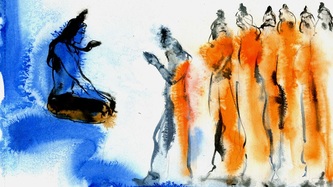
 | In recent days irrespective of their religions, or background Indian academics celebrate this day to thank their teachers and guides. Many schools, colleges and universities have events in which students thank their teachers as well as remember their past scholars. Alumni visit their teachers and present gifts as a gesture of gratitude. Students of Indian classical music and dance, which also follow the Guru shishya parampara, celebrate this holy festival around the world to offer their teachers respect and get their blessings. |
How can you Celebrate?
Realize who you are (Not your name or self, but a part of the larger cosmic structure). Think that you belong in this universe because of the knowledge transferred by your gurus, you fulfill the needs of your existence with the knowledge given by your gurus, you being on this planet, continent, country, state, city, and household, is all for a reason and it creates a completeness and it is because of the one. This very moment that you are alive, breathing and walking with flesh and blood on this universe is so precious and it is because of the one. When you look at yourself through this perspective, something in you uplifts your energy. That energy, is called enlightenment and it is offered to you by your Gurus.
Feel grateful for all the blessings that you have received from them. Be grateful for all the knowledge transferred, and see how that knowledge transformed you in your life as who you are. Remember and thank all the masters who have preserved this knowledge from ages, and brought it to us and celebrate them! If you pray and make a wish for what you want from Gurus and the wish will be bestowed.
THIS GURU POORNIMA IS VERY SPECIAL SINCE IT WAS ON A BLUE MOON DAY
Blue Moon is a second of two full moons in a single calendar month. An older definition of Blue Moon is that it’s the third of four full moons in a single season and it used to be a rare occurrence . Sometimes, they used to see an actual blue-colored moon. The term once in a blue moon also used to mean something very rare. This Guru Poornima on July 31st also occurred on that sort of special full moon day. HAPPY GURU POORNIMA TO ONE AND ALL. | 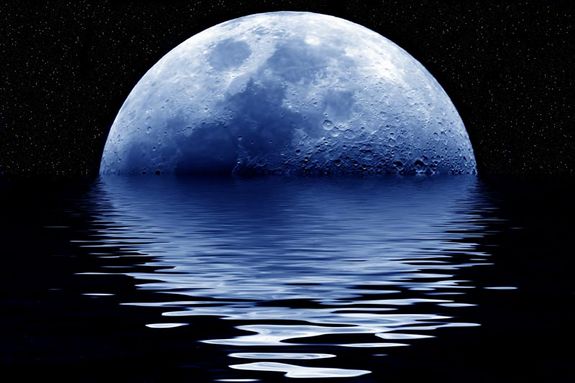 |
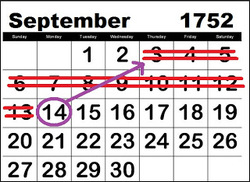
Interesting History of Mysterious 11 missing days in September 1752 |  |
The change from Julian Calender to Gregorian Calender
In 325 A.D Nicene council officially adopted the 'Julian Calendar' which declared that 'a year would be 365 days and 6 hours long' and March 25th being the 'New year'. Many centuries passed and at last astronomers found out the flaw in Julian calendar, that the average length of a year is suppose to be only 365 days, 5 hours and 49 minutes, which exceeded the newly measured 'Solar year' by 11 minutes. In reality the 11 minutes difference is really not that big of a deal, but over a period of time from 325 A.D to 1582 A.D, that is 1300 years, it sure would be a huge deal. So on February 24, 1582, Pope Gregory XIII ordered a new calendar, named as 'Gregorian Calendar'(papal bull)—a declaration from the leader of the Catholic Church—decreeing that those under the dominionship of his church would have to skip some days. Spain, large parts of Italy, the Netherlands, France, Portugal, Luxembourg, Poland and Lithuania all adopted Gregory’s bull the same year.
Britain had a large empire, and enough power to feel like it didn’t immediately need to cop to the Catholic calendar. But it all got rather confusing that people often wrote letters with two dates—one using the new Gregorian calendar, and the other using Julian calendar. Within the legislation, the government admitted that the old-style calendar had caused inconveniences, not only as it differed from the usage of neighboring nations, but also from the legal method of computation in Scotland, and from the common usage throughout the whole kingdom, and thereby frequent mistakes had occurred in the dates of deeds and other writings, and disputes aroused there from.
Eventually, Britain capitulated and instigated a NEW Calendar Act in 1750. In and throughout all its dominions and countries in Europe, Asia, Africa, and America, belonging or subject to Great Britain, the act continued, that the 2nd day of September 1752 accounted to be the 14th day of September, 11 days of the common calendar.”
Another piece of history happened due to this switch. The workers worked for 11 days less that month, got paid for the whole month. YAYYY!!! That's exactly how the concept of "paid leave" was born.
Britain had a large empire, and enough power to feel like it didn’t immediately need to cop to the Catholic calendar. But it all got rather confusing that people often wrote letters with two dates—one using the new Gregorian calendar, and the other using Julian calendar. Within the legislation, the government admitted that the old-style calendar had caused inconveniences, not only as it differed from the usage of neighboring nations, but also from the legal method of computation in Scotland, and from the common usage throughout the whole kingdom, and thereby frequent mistakes had occurred in the dates of deeds and other writings, and disputes aroused there from.
Eventually, Britain capitulated and instigated a NEW Calendar Act in 1750. In and throughout all its dominions and countries in Europe, Asia, Africa, and America, belonging or subject to Great Britain, the act continued, that the 2nd day of September 1752 accounted to be the 14th day of September, 11 days of the common calendar.”
Another piece of history happened due to this switch. The workers worked for 11 days less that month, got paid for the whole month. YAYYY!!! That's exactly how the concept of "paid leave" was born.
APRIL FOOLS DAY
In the Julian calendar, April was always used to be the first month of the year; but the Gregorian calendar observed January as its first month. Even after shifting, many people refused to give up on old traditions and continued celebrating 1st April as the New Year's Day. When simple orders didn't work, the King finally issued a royal dictum; which stated that those who celebrated 1st April as New Year would be labeled fools. From then on, 1st April became April Fool's Day.
The Chakras - Elements that are hidden in our system that keep us sane & insane
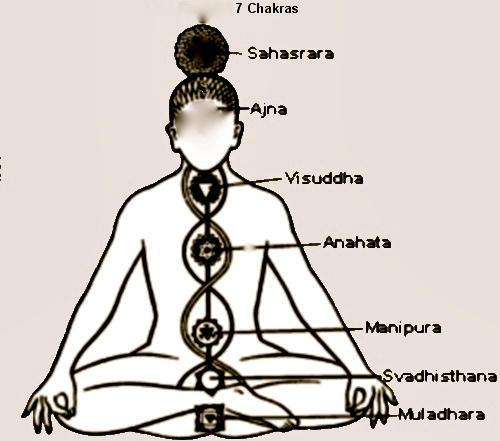
Are we aware of the fact that there are series of minor and major energy centers in our human system, which operate us to be sane or insane beings? They are called Chakras. The word Chakra in Sanskrit means "wheel" or "disk". There are 7 Chakras that operate us in and out and they usually correlate to different levels of consciousness, body functions, colors, elements, sounds, and much more. A small blockage or energy dysfunction in these Chakras can lead us into physiological, psychological, emotional, and spiritual disorders. What do we have to know about 7 Chakras!!
The first one is Muladhara Chakra or the Earth, located at the bottom of our spine. Muladhara Chakra deals with survival. Survival–The right to exist. It deals with tasks related to the material and physical world. Ability to stand up for oneself and security issues. This is blocked by our fears. If one may be concerned of their survival, they must first let go of these fears. It is believed that if anyone deals with imbalance of this Chakra usually Anemia, fatigue, lower back pain, sciatica, depression, frequent colds or cold hands and cold feet and so forth. This Chakra is associated with color Red. Muladhara Chakra Stimulants: Physical exercise and restful sleeps, gardening, pottery and clay. Consume food & drink that are red in color. Wear red gemstones, red clothing, and bathing in red, etc.
Second Chakra is Svadhishthana Chakra or the Water, located in the abdomen. This Chakra is responsible for pleasure or feelings. Feelings—The right to feel. Connected to our sensing abilities and issues related to feelings. Ability to be social and intimate. This Chakra often blocked by guilt. If we find any guilt from past or current and make sure to let go of them to get released from the poison of this energy. The Chakra imbalances include Eating disorders, Alcohol and drug abuse, Depression, Low back pain, Asthma or allergies, Candida & yeast infections, Urinary problems, Sensuality issues as well as impotency and frigidity and its often associated with color Orange. Svadhishthana Chakra Stimulants: Hot aromatic baths, water aerobics, massage, Embracing sensation (such as different food tastes). Orange colored food & drink consumption. Wearing Orange gemstones and orange clothing. Usage of orange oils or orange essential oils are good.
Third is Manipura Chakra or Fire, located at the stomach. It deals with willpower, and is blocked by shame. Personal willpower–The right to think. Balance of intellect, self-confidence and ego power. Ability to have self-control and humor. One must recognize the biggest disappointments in their life, and what they are ashamed of and get rid of that to regain the power. The imbalance of this Chakra will lead to digestive problems, ulcers, diabetes, hypoglycemia, constipation. Nervousness, toxicity, parasites, colitis, poor memory. Manipura Chakra Stimulants: Taking classes of one's interest, Reading informative books, Doing mind puzzles, Sunshine, Detoxification, Consume Yellow coloured food & drink, Wear Yellow gemstones and yellow clothing, Using yellow oils such as lemon or rosemary essential oils as this Chakra is associated with color Yellow.
Fourth is Anahatha Chakra or Air, located at the heart. It deals with love and relationship. Relationships–The right to love. Love, forgiveness, compassion. Ability to love and to be loved in return. Acceptance of oneself. This Chakra is blocked by grief. If you have lost someone’s love or life, you must realize love is a form of energy, and it swirls all around us. The love is still in your heart, and can be reborn in the shape of new love. An imbalance will cause Heart and breathing disorders, Heart decease, Breast cancer, Chest pain, High blood pressure, Passivity. Immune system problems, Muscular tension etc. Anahatha Chakra Stimulants: Nature walks, Time spent with family or friends, Consume food & drink in color Green, Wear Green gemstones and green clothing, Using green oils such as eucalyptus or pine essential oils, as it’s associated with color Green will help promote power of this Chakra.
Fifth is Vishuddha Chakra or the Sound, located at the throat. It deals with truth speaking. Speak–The right to speak. Learning to express oneself and one’s beliefs (truthful expression). Ability to trust, loyalty, organization and planning, and is usually blocked by lies. The lies we tell to ourselves. The Chakra imbalance may cause Thyroid dysfunctions, swollen glands, Mouth, jaw, tongue, neck and shoulders stiffness, Hyperactivity , sore throat, mouth ulcers, gum or tooth problems, teeth grinding, scoliosis, laryngitis, hearing problems etc. Vishuddha Chakra Stimulants: Singing, Creative, expressive, constructive communication, Contentment, centered, conscious listening, Positive self expression, Meaningful conversations Not to lie. Consume food & drink that are blue in color. wear Blue gemstones and blue clothing. Using blue oils such as chamomile or geranium essential oils and this Chakra is often associated with color blue.
Sixth is Aajna Chakra or the Light, located at the forehead (third eye). It deals with insight, and intuition. Intuition–The right to “see.” Trusting one’s intuition and insights. Developing one’s psychic abilities. Self-realization. Releasing hidden and repressed negative thoughts.and is blocked by illusions. The biggest illusion of all is the illusion of separation. Things we think separate are actually one and the same. We are all one, but we live as divided and multiplied. The imbalances include judgment, evaluation, concept of reality, confusion, fear of truth, discipline, lack of concentration. Aajna Stimulants: Ability to think reality into existence, Imagination, Intuition, Concentration and focus, Star gazing, Consume Indigo colored food & drink. Wearing Indigo gemstones and indigo clothing is better. Using indigo oils such as patchouli or frankincense essential oils. This Chakra is associated with color Indigo.
Seventh is Sahasrara Chakra or the Thought, located at the crown of the forehead. Knowingness–The right to aspire. Dedication to the divine consciousness and trusting the universe. Learning about one’s spirituality. Our connection to the concept of “God” or a higher intelligence. Integrating one’s consciousness and subconsciousness into the super-consciousness. It deals with pure cosmic energy, and is blocked by earthly attachments. One must find what attaches them into this world. Let the emotions flow and be forgotten and that would unlock this Chakra to gain the energy from the universe. Chakra imbalance include Headaches, Photosensitivity, Mental illness, Neuralgia, Senility, Right/left brain disorders and coordination problems, Epilepsy ,Varicose veins and blood vessel problems, Focusing on task, lack of purpose, loss of identity, disbelief in any spiritual realities, trust, selflessness, apathy, devotion, inspiration, values, ethics, sense of fear, materialism. Sahasrara Stimulants: Writing down one’s visions and inventions, feeling at one with the universe, open-minded, intelligent, thoughtful, understand and learn information more easily. Consume Violet food & drink. Wear Violet gemstones and violet clothing. Using violet oils such as lavender or jasmine essential oils, Skin Rashes, This Chakra is associated with color Violet.
Even though all of these chakras are very important factors for singing, the fifth Throat Chakra (The voice of God) is the most important one of all for singing. I will sure talk in detail in my next blog.
Second Chakra is Svadhishthana Chakra or the Water, located in the abdomen. This Chakra is responsible for pleasure or feelings. Feelings—The right to feel. Connected to our sensing abilities and issues related to feelings. Ability to be social and intimate. This Chakra often blocked by guilt. If we find any guilt from past or current and make sure to let go of them to get released from the poison of this energy. The Chakra imbalances include Eating disorders, Alcohol and drug abuse, Depression, Low back pain, Asthma or allergies, Candida & yeast infections, Urinary problems, Sensuality issues as well as impotency and frigidity and its often associated with color Orange. Svadhishthana Chakra Stimulants: Hot aromatic baths, water aerobics, massage, Embracing sensation (such as different food tastes). Orange colored food & drink consumption. Wearing Orange gemstones and orange clothing. Usage of orange oils or orange essential oils are good.
Third is Manipura Chakra or Fire, located at the stomach. It deals with willpower, and is blocked by shame. Personal willpower–The right to think. Balance of intellect, self-confidence and ego power. Ability to have self-control and humor. One must recognize the biggest disappointments in their life, and what they are ashamed of and get rid of that to regain the power. The imbalance of this Chakra will lead to digestive problems, ulcers, diabetes, hypoglycemia, constipation. Nervousness, toxicity, parasites, colitis, poor memory. Manipura Chakra Stimulants: Taking classes of one's interest, Reading informative books, Doing mind puzzles, Sunshine, Detoxification, Consume Yellow coloured food & drink, Wear Yellow gemstones and yellow clothing, Using yellow oils such as lemon or rosemary essential oils as this Chakra is associated with color Yellow.
Fourth is Anahatha Chakra or Air, located at the heart. It deals with love and relationship. Relationships–The right to love. Love, forgiveness, compassion. Ability to love and to be loved in return. Acceptance of oneself. This Chakra is blocked by grief. If you have lost someone’s love or life, you must realize love is a form of energy, and it swirls all around us. The love is still in your heart, and can be reborn in the shape of new love. An imbalance will cause Heart and breathing disorders, Heart decease, Breast cancer, Chest pain, High blood pressure, Passivity. Immune system problems, Muscular tension etc. Anahatha Chakra Stimulants: Nature walks, Time spent with family or friends, Consume food & drink in color Green, Wear Green gemstones and green clothing, Using green oils such as eucalyptus or pine essential oils, as it’s associated with color Green will help promote power of this Chakra.
Fifth is Vishuddha Chakra or the Sound, located at the throat. It deals with truth speaking. Speak–The right to speak. Learning to express oneself and one’s beliefs (truthful expression). Ability to trust, loyalty, organization and planning, and is usually blocked by lies. The lies we tell to ourselves. The Chakra imbalance may cause Thyroid dysfunctions, swollen glands, Mouth, jaw, tongue, neck and shoulders stiffness, Hyperactivity , sore throat, mouth ulcers, gum or tooth problems, teeth grinding, scoliosis, laryngitis, hearing problems etc. Vishuddha Chakra Stimulants: Singing, Creative, expressive, constructive communication, Contentment, centered, conscious listening, Positive self expression, Meaningful conversations Not to lie. Consume food & drink that are blue in color. wear Blue gemstones and blue clothing. Using blue oils such as chamomile or geranium essential oils and this Chakra is often associated with color blue.
Sixth is Aajna Chakra or the Light, located at the forehead (third eye). It deals with insight, and intuition. Intuition–The right to “see.” Trusting one’s intuition and insights. Developing one’s psychic abilities. Self-realization. Releasing hidden and repressed negative thoughts.and is blocked by illusions. The biggest illusion of all is the illusion of separation. Things we think separate are actually one and the same. We are all one, but we live as divided and multiplied. The imbalances include judgment, evaluation, concept of reality, confusion, fear of truth, discipline, lack of concentration. Aajna Stimulants: Ability to think reality into existence, Imagination, Intuition, Concentration and focus, Star gazing, Consume Indigo colored food & drink. Wearing Indigo gemstones and indigo clothing is better. Using indigo oils such as patchouli or frankincense essential oils. This Chakra is associated with color Indigo.
Seventh is Sahasrara Chakra or the Thought, located at the crown of the forehead. Knowingness–The right to aspire. Dedication to the divine consciousness and trusting the universe. Learning about one’s spirituality. Our connection to the concept of “God” or a higher intelligence. Integrating one’s consciousness and subconsciousness into the super-consciousness. It deals with pure cosmic energy, and is blocked by earthly attachments. One must find what attaches them into this world. Let the emotions flow and be forgotten and that would unlock this Chakra to gain the energy from the universe. Chakra imbalance include Headaches, Photosensitivity, Mental illness, Neuralgia, Senility, Right/left brain disorders and coordination problems, Epilepsy ,Varicose veins and blood vessel problems, Focusing on task, lack of purpose, loss of identity, disbelief in any spiritual realities, trust, selflessness, apathy, devotion, inspiration, values, ethics, sense of fear, materialism. Sahasrara Stimulants: Writing down one’s visions and inventions, feeling at one with the universe, open-minded, intelligent, thoughtful, understand and learn information more easily. Consume Violet food & drink. Wear Violet gemstones and violet clothing. Using violet oils such as lavender or jasmine essential oils, Skin Rashes, This Chakra is associated with color Violet.
Even though all of these chakras are very important factors for singing, the fifth Throat Chakra (The voice of God) is the most important one of all for singing. I will sure talk in detail in my next blog.

EXERCISE YOUR BRAIN THROUGH MUSIC:
We all agree upon one fact that in order to live a healthy and happy lifestyle one needs to do at least a minimal physical exercise that is recommended by every health care adviser. The usual seven benefits of regular physical activity to feel better, to have more energy and perhaps even to live longer are: 1. To control weight, 2. To combat health conditions and diseases, 3.To improve mood, 4. To boost energy, 5. To promote better sleep, 6. To put the spark into your “FAMILY LIFE”, 7. To have fun doing it.
The same way music exercises one’s brain that promotes 1. Better Memory, 2. To Get Things done, 3. Safer Driving, 4. Self Confidence, 5. Motivated to try new Things, 6. Quicker Reactions, 7. Sharper Listening, 8. Lower Crash Risk, 9. Finding Correct Words, 10. Sharper Vision, 11. Faster Thinking, 12. Good Mood. Are you aware that Musicians’ brains are often used as models of neuroplasticity. Indeed, many studies have shown that music training can change the brain. Musicians have larger brain volume in areas that are important for singing songs or playing an instrument: motor, auditory and visuo-spatial regions. Specifically, musicians may have an advantage for processing speech in challenging listening environments compared with non-musicians.
When we sing or play any musical instrument, we literally exercise our brains in a very unique manner. There are enough scientific evidences to prove that the music training, music experience, music exposure, music education, or even listening to music can change or alter one’s brain functionality. It definitely molds our thinking style to the way we never used to think before, and it trains many other cognitive facilities that have nothing to do with music as well.
WHAT DOES THE TERM ‘EAR WORM’ MEAN?
Have you ever experienced that a specific section of a song gets stuck in your head for a period of time, which bothers you so much at times? The part that is stuck in your head is often not the part that you really like the most. The part that plays over and over, as if a repaired loop button in your brain’s music player is stuck. Researchers believe that these bothering segments of music as "EAR WORMS." No one yet found why, when, how it happens, but many scientists and researchers are looking into finding out scientific reasons.
Daniel Levitin a psychologist who studies the neuroscience of music at McGill University in Montreal, Quebec says that the segment that usually gets stuck in people's heads tend to be melodically or rhythmically very simple and usually it’s just a segment of the song, never an entire song. He believes that listening to a different song or tune may help us get rid of the ear worm. "What Levitin believes is that what our brain thinks is going on in the neural circuits which get stuck in a repeating loop and the brain plays it over and over again. He says that in rare cases, ear worms can actually be harmful and can disturb people's everyday’s life. There are many incidents that people have to take anti-anxiety medications, which is given for mind obsessive-compulsive disorder, drugs that relax the neural circuits that are stuck in an infinite loop when they couldn’t sleep, focus or work because of songs that won't leave their mind.
We all agree upon one fact that in order to live a healthy and happy lifestyle one needs to do at least a minimal physical exercise that is recommended by every health care adviser. The usual seven benefits of regular physical activity to feel better, to have more energy and perhaps even to live longer are: 1. To control weight, 2. To combat health conditions and diseases, 3.To improve mood, 4. To boost energy, 5. To promote better sleep, 6. To put the spark into your “FAMILY LIFE”, 7. To have fun doing it.
The same way music exercises one’s brain that promotes 1. Better Memory, 2. To Get Things done, 3. Safer Driving, 4. Self Confidence, 5. Motivated to try new Things, 6. Quicker Reactions, 7. Sharper Listening, 8. Lower Crash Risk, 9. Finding Correct Words, 10. Sharper Vision, 11. Faster Thinking, 12. Good Mood. Are you aware that Musicians’ brains are often used as models of neuroplasticity. Indeed, many studies have shown that music training can change the brain. Musicians have larger brain volume in areas that are important for singing songs or playing an instrument: motor, auditory and visuo-spatial regions. Specifically, musicians may have an advantage for processing speech in challenging listening environments compared with non-musicians.
When we sing or play any musical instrument, we literally exercise our brains in a very unique manner. There are enough scientific evidences to prove that the music training, music experience, music exposure, music education, or even listening to music can change or alter one’s brain functionality. It definitely molds our thinking style to the way we never used to think before, and it trains many other cognitive facilities that have nothing to do with music as well.
WHAT DOES THE TERM ‘EAR WORM’ MEAN?
Have you ever experienced that a specific section of a song gets stuck in your head for a period of time, which bothers you so much at times? The part that is stuck in your head is often not the part that you really like the most. The part that plays over and over, as if a repaired loop button in your brain’s music player is stuck. Researchers believe that these bothering segments of music as "EAR WORMS." No one yet found why, when, how it happens, but many scientists and researchers are looking into finding out scientific reasons.
Daniel Levitin a psychologist who studies the neuroscience of music at McGill University in Montreal, Quebec says that the segment that usually gets stuck in people's heads tend to be melodically or rhythmically very simple and usually it’s just a segment of the song, never an entire song. He believes that listening to a different song or tune may help us get rid of the ear worm. "What Levitin believes is that what our brain thinks is going on in the neural circuits which get stuck in a repeating loop and the brain plays it over and over again. He says that in rare cases, ear worms can actually be harmful and can disturb people's everyday’s life. There are many incidents that people have to take anti-anxiety medications, which is given for mind obsessive-compulsive disorder, drugs that relax the neural circuits that are stuck in an infinite loop when they couldn’t sleep, focus or work because of songs that won't leave their mind.
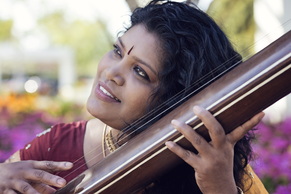
Many times I came across observing several musicians try hard to harmonize the Indian Ragas while exploring the other type of music, get their super enthusiastic bubble poked by classically trained, learned musicians around them. Even though seeing them get discouraged and disappointed saddened me inner sense, their stubborn enthusiastic will to not to give up on their ideologies on harmonizing the Indian Ragas made me smile big. That very reason kindled my sixth sense to think about writing this article of what solution could possibly be offered to those musicians to get them understand 'why' and 'why not' and Dos and Don't s of Harmonizing Classical Ragas.
The world music systems can be classified as either Harmonic System or Melodic System. Indian music (both Carnatic from Southern India and Hindustani from the Northern India) belongs to the Melodic System. In a Melodic System, each individual note follows another with a regular sequence of pitch, rhythm, and tempo but in the Harmonic System, music progresses by group of notes, called chords. The permutations and combinations of notes are of in uniform patterns. In Indian music, each Swara or note is linked to another note. Rarely does a note is sung or played as a single isolated note (e.g. staccato in Western music).
Now here comes the reason why there is a very limited scope for a Raga to be harmonized. There is nothing negative about fusing more than one type of music, as it might sure bring gorgeous colors, glitters, and flavors to the project. As a matter of fact it would offer completely a different perspective and listening experience to the modern listeners' musical experience. But on the other hand there is also a very high possibility that everything can also go wrong, when a Indian Raga is involved in a harmonization. It not only may lose its scientific purity and aesthetic clarity and everything else that come along with it such as mood, essence, sensitivity and lot more. There also is a possibility for a structural damage of the raga, that might lead to a destruction of its purpose and value and aesthetics.
When a particular Swara of a given Raga is moved to a different position within the same Raga, in order to get them harmonized, it may go through a 'Model Shift' to its tone that can completely transform the Raga into a totally different Raga or mixture of Ragas or 'NO' Raga at all. This process is called 'Model Shift of Tonic' or 'Graha Bedham'. The 'Model Shift of Tonic' or 'Graha Bedham' in Carnatic Classical music system is a whole big high level musical ordeal. Its nothing but a special technique of shifting the tonic Swara to another Swara in which a new Raga can be created from the original Raga. In this process changing of its Swaras' positions occurs within the scientific boundaries of any selected Raga. This process or term cannot be confused with the term harmonization as Graha Bedham still follows all the rules of the Melodic System and not Hormonic System. When time permits I sure will share my thought in elaborating the 'Graha Bedham' in detail in my up coming future blogs.
But to bring this blog to a conclusion, I believe that, this above mentioned rules might be the very reason for why a highly trained and learned Indian Classical Musician would hesitate to harmonize the Indian Ragas in any given fusion music projects.
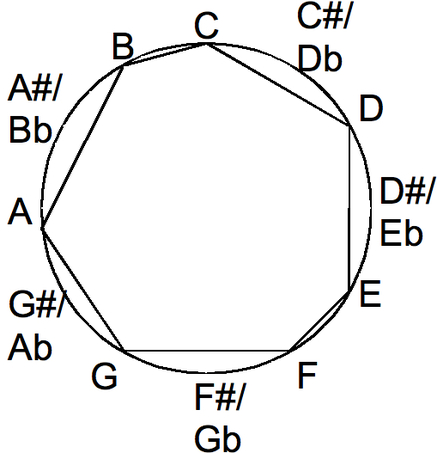
Below is the map of the Indian Swaras and its Western Equivalent:
The world music systems can be classified as either Harmonic System or Melodic System. Indian music (both Carnatic from Southern India and Hindustani from the Northern India) belongs to the Melodic System. In a Melodic System, each individual note follows another with a regular sequence of pitch, rhythm, and tempo but in the Harmonic System, music progresses by group of notes, called chords. The permutations and combinations of notes are of in uniform patterns. In Indian music, each Swara or note is linked to another note. Rarely does a note is sung or played as a single isolated note (e.g. staccato in Western music).
Now here comes the reason why there is a very limited scope for a Raga to be harmonized. There is nothing negative about fusing more than one type of music, as it might sure bring gorgeous colors, glitters, and flavors to the project. As a matter of fact it would offer completely a different perspective and listening experience to the modern listeners' musical experience. But on the other hand there is also a very high possibility that everything can also go wrong, when a Indian Raga is involved in a harmonization. It not only may lose its scientific purity and aesthetic clarity and everything else that come along with it such as mood, essence, sensitivity and lot more. There also is a possibility for a structural damage of the raga, that might lead to a destruction of its purpose and value and aesthetics.
When a particular Swara of a given Raga is moved to a different position within the same Raga, in order to get them harmonized, it may go through a 'Model Shift' to its tone that can completely transform the Raga into a totally different Raga or mixture of Ragas or 'NO' Raga at all. This process is called 'Model Shift of Tonic' or 'Graha Bedham'. The 'Model Shift of Tonic' or 'Graha Bedham' in Carnatic Classical music system is a whole big high level musical ordeal. Its nothing but a special technique of shifting the tonic Swara to another Swara in which a new Raga can be created from the original Raga. In this process changing of its Swaras' positions occurs within the scientific boundaries of any selected Raga. This process or term cannot be confused with the term harmonization as Graha Bedham still follows all the rules of the Melodic System and not Hormonic System. When time permits I sure will share my thought in elaborating the 'Graha Bedham' in detail in my up coming future blogs.
But to bring this blog to a conclusion, I believe that, this above mentioned rules might be the very reason for why a highly trained and learned Indian Classical Musician would hesitate to harmonize the Indian Ragas in any given fusion music projects.
Below is the map of the Indian Swaras and its Western Equivalent:
Kattai Method 1 1.5 2 2.5 3 4 4.5 5 5.5 6 6.5 7 | Indian Swaras S R1 R2 / G1 R3 / G2 G3 M1 M2 P D1 D2 /N1 D3 / N2 N3 | Western Equivalent C C# or Db D D# or Eb E F F# or Gb G G# or Ab A A# Bb B |
It is very hard to pin point the evolution or the origin of exact time frame of today's Carnatic music. Carnatic music definitely went through tremendous amount of changes in its practical as well as the theoretical forms that most definitely taken place from Pre Vedic times till the present day. More than enough historical, geographical, scientific evidences are available for us to trace most of the evolutionary changes of contemporary Carnatic music.
The first and fore most believed origin of Carnatic music is the divine origin. According to the ancient Indian beliefs, most of the Fine Art forms are originated from divine sources. So did Carnatic music believe to be originated directly from the Gods and Goddesses. Many mythological study and treatises also talk about this divine origin.
The next believed source of origin is natural origin. The natural tones and sounds were emanated from plants, trees, barks such as when air passed through the hollow stems of bamboo logs, ancient musical human observed the phenomenon and developed a bamboo flute. Similarly the sounds and tones of some animals and birds were connected with the origin of some notes/swarms is referred in many ancient treatises. The keen musical sense and ability of ancient human's observation simulated and distinguished the frequencies, qualities and timbre of those sounds also was another factor of the evolution of Carnatic music. The origination of Sa, Ri/Re, Ga, Ma, Pa, Da/Dha, and Ni from the sound of a different animals and birds are as follow:
Shadjam = Sa - Cry of the peacock
Rishabham = Ri or Re - Lowing of the bull
Gaandhaaram = Ga - Bleating of a goat
Madhyamam = Ma - Call of the heron
Panchamam = Pa - Call of the cuckoo bird
Dhaivatham = Da or Dha - Neighing of the horse
Nishaadham = Ni - Trumpeting of the elephant
Folk origin is another contributing factor. , Its believed that humans from folk lore based on different types of work they did, languages they spoke, culture they dealt with contributed a major part in the evolution of music except the folk music evokes much spontaneity, but the classical system is more organized.
It is generally agreed upon the fact that the Vedas are the most probable source of Carnatic music as a matter of fact Indian music. The term “Veda” literally means knowledge. The thousands of hymns in four different Vedas 1.Rig Veda, 2.Yajur Veda, 3. Sama Veda and 4. Atharvana Veda were dedicated to the Gods and goddesses of Hindu religion, in the forms of chants that were passed by oral tradition from generation to generation. Of these four Vedas, the Sama Veda that used to be sung during Vedic sacrifices is said to have laid the foundation for Carnatic music. Sama Veda consists mostly of Rig Vedic hymns, set to musical tunes. These, using musical notes (3 notes - 7 notes), sometimes accompanied by a musical instrument.
There are several other references about music and musical instruments apart from the Veda sources such as, Upanishads, Brahmans and Puranas and epics such as Ramayana and Mahabharata. Bharata's Natya Sastra is believed to be the greatest source to the similar music system in practice in many respects to the present Carnatic system.
The native Dravidians of Southern India practiced Tamil music. Some of the Tamil Sangam literature works such as Silappadikaram, Tolkappiam, and many other works describes of seven notes, octaves, Model shift of tonic, ascending and descending scales with old Dravidian. In the ancient Tamil music, the term 'Pann' referred to that of modern Raga. The rhythmic metrics found in some of these sacred musical forms such as Tevaram, Tiruppugazh, Thiruvachakam etc., resemble the tala patterns of present day music. Many scholars believe that the ancient Tamil music might be an important source for the evolution of Carnatic music where it might have been derived. The word “Carnatic” came to represent the South Indian Classical Music as a separate musical system only after the Sangeetha Rathnakara of Sarngadeva (1210-1247). Only after the latter half of the 14th century a distinct demarcation between Hindustani and Carnatic music as two different musical systems of Indian classical music is seen. There are references to prove that Classical Carnatic music flourished in the southern Indian region, especially in Vijayanagara and Tanjure. The present form of Carnatic music is based on historical developments based from the traces to the 15th - 16th AD and thereafter.
Many of the important musical forms such as Tevaram, Divyaprabandham, Tiruppavai, Ashtapadis, Padams, Kritis, were composed along with the Abhyasa ganams, such as Swaravalis, Alankara, Gitams, for beginners. Tallapakkam Annamacharya (1425 - 1503 AD), composed with new structure called Kriti, which had, three sections, of the Pallavi, Anupallavi and Charanam. This structure was accepted widely and was popularized by later composers, in particular, the Carnatic Trinity. Thyagaraja, Muthuswami Dikshitar, Syama Sastry. Annamacharya is credited to have composed about thirty two thousand compositions of which around twelve thousand have been traced and some of these have been still preserved in copper plates.
Purandaradasa (1484 - 1564 AD) is known as the Sangeeta Pitamaha (the godfather of Carnatic music). Purandara dasa was a prolific composer, and laid the foundation for the systematic music educational exercise system. He is credited to have formulated the Swaravali exercises for early practice, apart from composing simple devotional songs, Gitams, and Kritis with high devotional and philosophical essence.
The golden age of Carnatic music is the 17th century and many important milestones of Carnatic music where evolved during that time. Some of the most important developments in both Lakshana (theoretical) and Lakshya (practical) aspects took place during this period. Venkatamakhi formulated a structured scientific 72 Melakarta scheme in his treatise Chaturdandi Prakasika in this century. Many other scholars created several other treatises following Venkatamakhi. The three great composers of Carnatic music, who were later celebrated as the Musical Trinity (Trimurti) - Syama Sastri (1762 - 1827) Tyagaraja (1767-1847) and Muthuswami Dikshitar (1776-1835) were born during the period from 1763 - 1775 AD. All three of them contributed their immense knowledge, devotional discipline and greatest musicianship with great creativity and innovative ideas. Their contribution in Carnatic music is invaluable. The art of composing music was elevated to great heights during their time. Other great composers who have contributed to music compositions include Swati Tirunal (1813-1847), Vina Kuppayyar, Subbaraya Sastri, Gopalakrishna Bharati, Ghanam Krishna Iyer, Patnam Subramanya Iyer, Koteeswara Iyer, Muthaiah Bhagavatar, Mysore Vasudevachar and Papanasam Sivan and so forth. 72 Melakarta scheme is accountable for the transformation of South Indian Music. Hundreds and thousands of Ragas came into existence by the compositions of Carnatic music Trinity along with those other great composers.
In 19th century, musical notation system was developed, to represent the musical compositions in written form. While several other great composers were working to improve the theoretical aspect of music, many others were trying to keep the equal balance towards the practical aspect for the refinement of Carnatic system, to keep it fresh and alive.
Large repertoire of musical forms was developed, by creating new structural arrangements. These include Swarajati Varnam, Kriti, Padam, Javali, Tillana, and so forth. These musical forms have continued to remain popular in the 20th century.
Carnatic music and musicians was mostly limited within the major temples and royal courts until late 19t century. Few rich landowners, who arranged concerts for various events, also maintained it. From the 20th century, this typical patronage has taken a different route since numerous Fine Arts organizations (Sabhas), Private or group of promoters of arts and culture, well developed corporate sponsors have involved to give a better and professional outlook to this art-form. As a result this change, Carnatic music is heard not only in major cities in India, but also in major venues in Asia, Europe, North and South Americas, and in most other continents of the world.
Carnatic music learning and the process of teaching have also adopted drastic changes based on student and teachers different life style, over years. The traditional Guru Kula system has given way to an institutional system of training in the 20th century. Several good musicians have taken teaching as full time carrier path. Modern educational tools, computer and recording technology, internet and mass media communications have played a vital roll not only for the enormous growth of Carnatic Music but also to make the Carnatic music education available students all around the globe. Through these major worldwide changes in the system, Carnatic music has not only gained new dynamism, but has also retained its pure beauty within its own traditional framework.
The first and fore most believed origin of Carnatic music is the divine origin. According to the ancient Indian beliefs, most of the Fine Art forms are originated from divine sources. So did Carnatic music believe to be originated directly from the Gods and Goddesses. Many mythological study and treatises also talk about this divine origin.
The next believed source of origin is natural origin. The natural tones and sounds were emanated from plants, trees, barks such as when air passed through the hollow stems of bamboo logs, ancient musical human observed the phenomenon and developed a bamboo flute. Similarly the sounds and tones of some animals and birds were connected with the origin of some notes/swarms is referred in many ancient treatises. The keen musical sense and ability of ancient human's observation simulated and distinguished the frequencies, qualities and timbre of those sounds also was another factor of the evolution of Carnatic music. The origination of Sa, Ri/Re, Ga, Ma, Pa, Da/Dha, and Ni from the sound of a different animals and birds are as follow:
Shadjam = Sa - Cry of the peacock
Rishabham = Ri or Re - Lowing of the bull
Gaandhaaram = Ga - Bleating of a goat
Madhyamam = Ma - Call of the heron
Panchamam = Pa - Call of the cuckoo bird
Dhaivatham = Da or Dha - Neighing of the horse
Nishaadham = Ni - Trumpeting of the elephant
Folk origin is another contributing factor. , Its believed that humans from folk lore based on different types of work they did, languages they spoke, culture they dealt with contributed a major part in the evolution of music except the folk music evokes much spontaneity, but the classical system is more organized.
It is generally agreed upon the fact that the Vedas are the most probable source of Carnatic music as a matter of fact Indian music. The term “Veda” literally means knowledge. The thousands of hymns in four different Vedas 1.Rig Veda, 2.Yajur Veda, 3. Sama Veda and 4. Atharvana Veda were dedicated to the Gods and goddesses of Hindu religion, in the forms of chants that were passed by oral tradition from generation to generation. Of these four Vedas, the Sama Veda that used to be sung during Vedic sacrifices is said to have laid the foundation for Carnatic music. Sama Veda consists mostly of Rig Vedic hymns, set to musical tunes. These, using musical notes (3 notes - 7 notes), sometimes accompanied by a musical instrument.
There are several other references about music and musical instruments apart from the Veda sources such as, Upanishads, Brahmans and Puranas and epics such as Ramayana and Mahabharata. Bharata's Natya Sastra is believed to be the greatest source to the similar music system in practice in many respects to the present Carnatic system.
The native Dravidians of Southern India practiced Tamil music. Some of the Tamil Sangam literature works such as Silappadikaram, Tolkappiam, and many other works describes of seven notes, octaves, Model shift of tonic, ascending and descending scales with old Dravidian. In the ancient Tamil music, the term 'Pann' referred to that of modern Raga. The rhythmic metrics found in some of these sacred musical forms such as Tevaram, Tiruppugazh, Thiruvachakam etc., resemble the tala patterns of present day music. Many scholars believe that the ancient Tamil music might be an important source for the evolution of Carnatic music where it might have been derived. The word “Carnatic” came to represent the South Indian Classical Music as a separate musical system only after the Sangeetha Rathnakara of Sarngadeva (1210-1247). Only after the latter half of the 14th century a distinct demarcation between Hindustani and Carnatic music as two different musical systems of Indian classical music is seen. There are references to prove that Classical Carnatic music flourished in the southern Indian region, especially in Vijayanagara and Tanjure. The present form of Carnatic music is based on historical developments based from the traces to the 15th - 16th AD and thereafter.
Many of the important musical forms such as Tevaram, Divyaprabandham, Tiruppavai, Ashtapadis, Padams, Kritis, were composed along with the Abhyasa ganams, such as Swaravalis, Alankara, Gitams, for beginners. Tallapakkam Annamacharya (1425 - 1503 AD), composed with new structure called Kriti, which had, three sections, of the Pallavi, Anupallavi and Charanam. This structure was accepted widely and was popularized by later composers, in particular, the Carnatic Trinity. Thyagaraja, Muthuswami Dikshitar, Syama Sastry. Annamacharya is credited to have composed about thirty two thousand compositions of which around twelve thousand have been traced and some of these have been still preserved in copper plates.
Purandaradasa (1484 - 1564 AD) is known as the Sangeeta Pitamaha (the godfather of Carnatic music). Purandara dasa was a prolific composer, and laid the foundation for the systematic music educational exercise system. He is credited to have formulated the Swaravali exercises for early practice, apart from composing simple devotional songs, Gitams, and Kritis with high devotional and philosophical essence.
The golden age of Carnatic music is the 17th century and many important milestones of Carnatic music where evolved during that time. Some of the most important developments in both Lakshana (theoretical) and Lakshya (practical) aspects took place during this period. Venkatamakhi formulated a structured scientific 72 Melakarta scheme in his treatise Chaturdandi Prakasika in this century. Many other scholars created several other treatises following Venkatamakhi. The three great composers of Carnatic music, who were later celebrated as the Musical Trinity (Trimurti) - Syama Sastri (1762 - 1827) Tyagaraja (1767-1847) and Muthuswami Dikshitar (1776-1835) were born during the period from 1763 - 1775 AD. All three of them contributed their immense knowledge, devotional discipline and greatest musicianship with great creativity and innovative ideas. Their contribution in Carnatic music is invaluable. The art of composing music was elevated to great heights during their time. Other great composers who have contributed to music compositions include Swati Tirunal (1813-1847), Vina Kuppayyar, Subbaraya Sastri, Gopalakrishna Bharati, Ghanam Krishna Iyer, Patnam Subramanya Iyer, Koteeswara Iyer, Muthaiah Bhagavatar, Mysore Vasudevachar and Papanasam Sivan and so forth. 72 Melakarta scheme is accountable for the transformation of South Indian Music. Hundreds and thousands of Ragas came into existence by the compositions of Carnatic music Trinity along with those other great composers.
In 19th century, musical notation system was developed, to represent the musical compositions in written form. While several other great composers were working to improve the theoretical aspect of music, many others were trying to keep the equal balance towards the practical aspect for the refinement of Carnatic system, to keep it fresh and alive.
Large repertoire of musical forms was developed, by creating new structural arrangements. These include Swarajati Varnam, Kriti, Padam, Javali, Tillana, and so forth. These musical forms have continued to remain popular in the 20th century.
Carnatic music and musicians was mostly limited within the major temples and royal courts until late 19t century. Few rich landowners, who arranged concerts for various events, also maintained it. From the 20th century, this typical patronage has taken a different route since numerous Fine Arts organizations (Sabhas), Private or group of promoters of arts and culture, well developed corporate sponsors have involved to give a better and professional outlook to this art-form. As a result this change, Carnatic music is heard not only in major cities in India, but also in major venues in Asia, Europe, North and South Americas, and in most other continents of the world.
Carnatic music learning and the process of teaching have also adopted drastic changes based on student and teachers different life style, over years. The traditional Guru Kula system has given way to an institutional system of training in the 20th century. Several good musicians have taken teaching as full time carrier path. Modern educational tools, computer and recording technology, internet and mass media communications have played a vital roll not only for the enormous growth of Carnatic Music but also to make the Carnatic music education available students all around the globe. Through these major worldwide changes in the system, Carnatic music has not only gained new dynamism, but has also retained its pure beauty within its own traditional framework.
Bring the Joy of Music Into Your Family & In Your Child’s Life For A Happy & Healthy Relationship In Your Home.
Few Creative Ideas to Explore Joy of Music as a Family.
Way back in the ‘60s & 70s families used to gather around in the evenings and on holidays and sing songs together, or you were forced to listen to that small mono sound transistor Radio's non stop classical, devotional or other favorite music on parents or grand parents favorite FM channel in the morning and/or in the evenings on a day to day basis. Over the years as the technology took over the world the computer games and smartphones took over the families of new generation's habits, we seem to have lost this family past time music get-to-gathers, but there are still ways that families can do to explore the joy of music on to our current and future generations. There sure are several fun and inexpensive ways for parents to explore the music with their families and children. Here are some interesting ideas you may explore with your family:
Few Creative Ideas to Explore Joy of Music as a Family.
Way back in the ‘60s & 70s families used to gather around in the evenings and on holidays and sing songs together, or you were forced to listen to that small mono sound transistor Radio's non stop classical, devotional or other favorite music on parents or grand parents favorite FM channel in the morning and/or in the evenings on a day to day basis. Over the years as the technology took over the world the computer games and smartphones took over the families of new generation's habits, we seem to have lost this family past time music get-to-gathers, but there are still ways that families can do to explore the joy of music on to our current and future generations. There sure are several fun and inexpensive ways for parents to explore the music with their families and children. Here are some interesting ideas you may explore with your family:
- Sing With Your Child – You don't have to prove to be the next Super Singer or American Idol, but chances are your children and family will definitely think of you as their roll model/idol even if you can’t carry a proper tune – young children will not even notice rather will have lots of fun correcting or teaching you to carry the right tune and you’ll probably have a lot of fun together.
- Create Music with Things Around the House –Get creative and look for every day things that you can transform into a musical instrument such as pots & pans, spoons & forks, sticks & towels. Don't forget that your counter tops or table top can turn into your drum machine, sound of your ceiling fan can be your pitch pipe. Cups with different water level can be your musical instrument.
- Introduce Your Child To All Types of Music – Do not get stuck to only music from one ethnicity or single genre. Add variety to your child’s life by playing a different type of music each day, whether it’s Indian, Western, Japanese, or Indonesian , classical, pop, movie song, country, rock, rap, jazz, hits of the ‘50s, ‘60s and ‘70s, camp songs, or simply good old-fashioned children’s music. It sure will create great open mindedness, appreciation towards wholeness, well roundness and literacy in all music.
- Buy A Small Instrument – A cheap way to introduce your child to an instrument and have them experiment with creating different sounds and tunes.
- Let Your Child See You Play or Sing – If you play the piano or any other instrument or sing any type of music, involve your child: have her sit on your lap while you play or sing a few tunes and talk about the parts of the instrument you play or phrases of the tune you sing, or explore together.
- Try a Music Class – There are so many classes available and some of them are surprisingly affordable. Pick one that offers a good variety of activities such as music making with easy instruments, singing that gives motivation, fun and education while enjoying tunes, and music listening and reproducing. Make sure to try to select a class that’s age-appropriate.
- Music is a Performing Arts – Kids love to see themselves in spot lights, hear themselves loud on the microphones and be on a stage involved in an act . Just put on to their favorite music and encourage your children to dance, sing, and enjoy themselves.
- I guarantee you that you sure bring the Joy of music into your family & in your child’s life for a happy & healthy relationship in your home.
Author
Rose Muralikrishnan
Archives
October 2016
July 2015
April 2015
April 2014
July 2013
May 2013
April 2013
Categories
All
Carnatic Education
Carnatic Music Learning
Happy Family
Indian Music
Joy Of Music
Music Education
Music Learning
 RSS Feed